
Buffer, Jaipur
There is a particular quality to spaces that do not try too hard. You notice it before you can name it. The absence of effort where effort is usually performed. Buffer, a co-working space in Jaipur, has this quality. It arrives the moment you step in and does not announce itself again.
The word the designers at Tatvam have anchored the project to is Samanvay. Harmony. Not the decorative kind — the structural kind. The kind that is less about what you put in a room and more about how those things agree with each other. Walking through the space, it is possible to see what they mean.

The floor is the first thing. A deep red curves through cream, the line easy and unforced. It does not divide so much as move, the way water moves around something rather than stopping at it. Different zones of the space are held within this curve without being declared by it. There are no signs pointing you toward the meeting room or the cabin or the corridor where someone has already pulled up a chair. The plan simply allows for all of it.
The partitions are fluted glass set in dark wood frames. They separate rooms from corridor, cabin from open area, but they do so with some generosity. Light passes through them. In the morning it is one quality; by afternoon, another. The shadows they cast shift through the day the way shadows in an old house do, unpredictably, in response to the sun rather than to a switch.
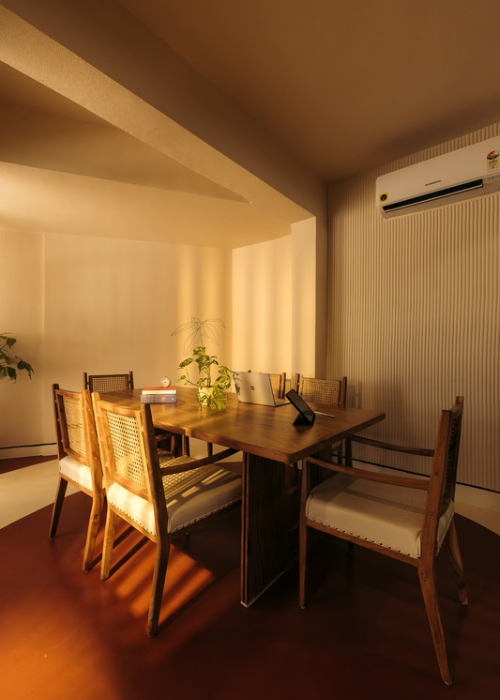
Inside the meeting room, a long solid wood table runs most of the length of the space. The grain has not been filled or flattened. Cane-back chairs sit around it, their seats upholstered in a neutral that does not compete. On the wall, a wire line drawing of a plant. On the windows, the city outside, filtered and softened. It is a room that asks you to stay for a while, which is a rarer thing in a workspace than it should be.
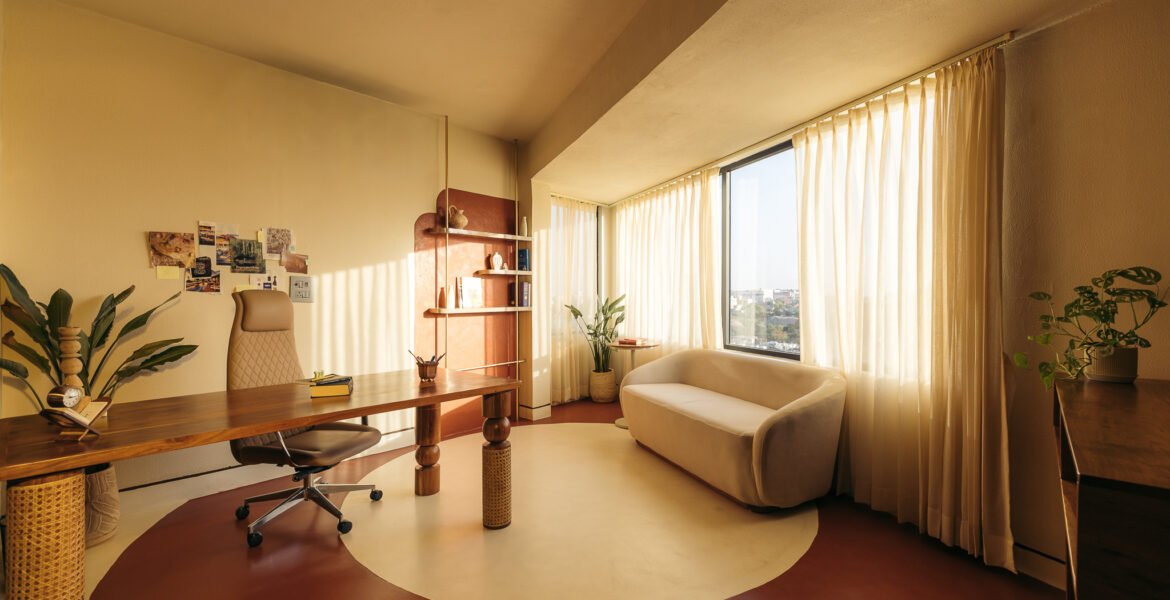
The private cabin reads differently. Here the floor inlay returns, the cream circle set against red, and a terracotta plaster panel holds brass rod shelves with ceramics and books arranged on them without the self-consciousness of a styled shelf. There is a sofa near the window. The light by this point in the afternoon has gone gold. The city sits at the glass and the curtains soften it further. A room that could belong to someone, rather than to everyone.
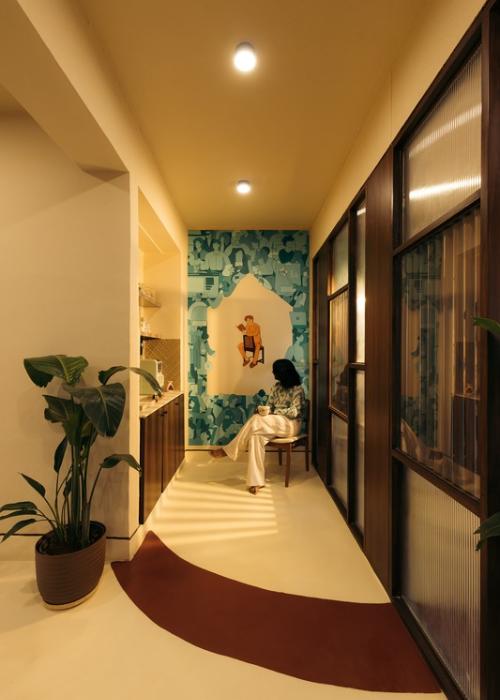
What Buffer resists, consistently and without making a point of it, is the visual language of productivity. No exposed concrete, no motivational type on the walls, no furniture chosen to photograph well from above. Instead there is cane, wood, plaster, a mural in teal that covers a corridor wall end to end. Materials that carry time in them. That look, if anything, more themselves as the day goes on.
There is a chair in the corridor. Just one, pulled up near the mural. Someone sat there and found it good enough to stay. That detail, more than anything else in the space, is the one that holds.
Design: Ar. Raghu Pratap Singh, Tatvam